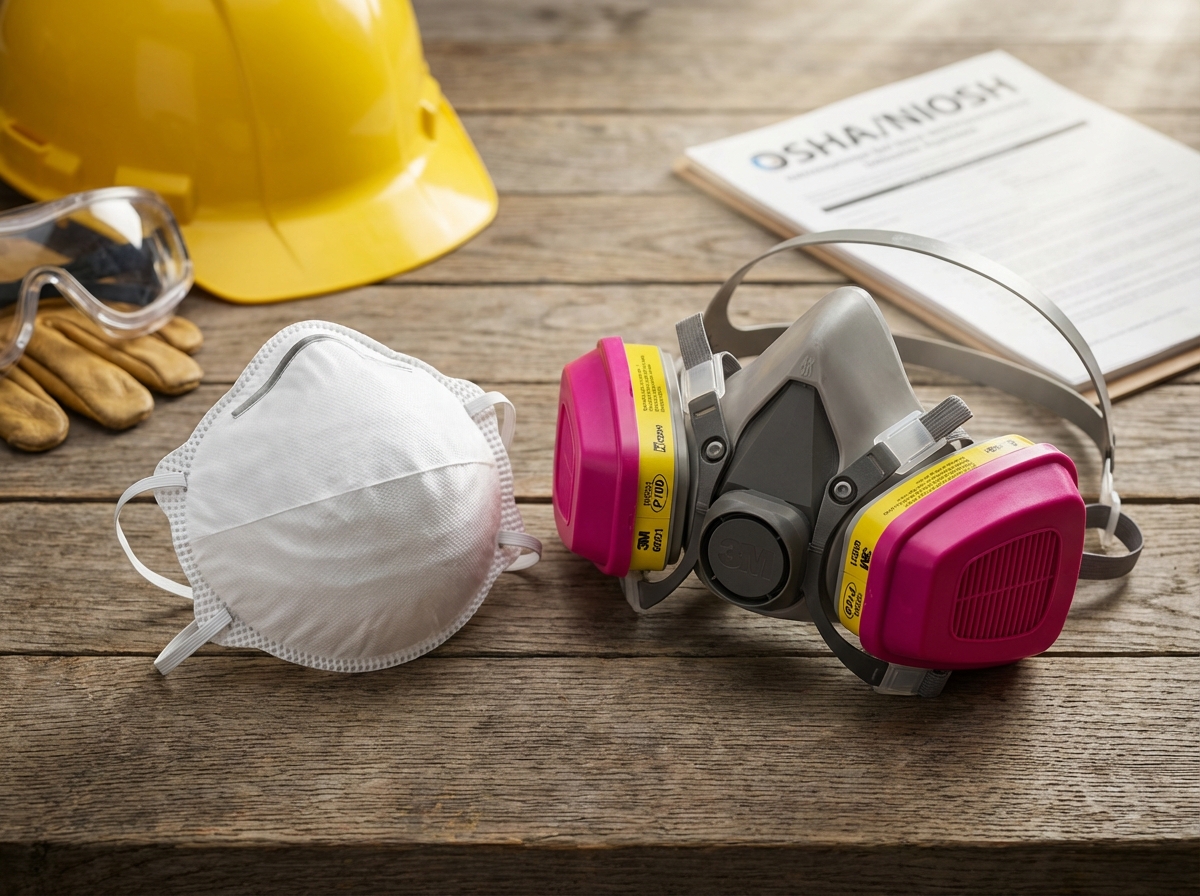
Choosing between N95 and P100 respirators affects protection, comfort, compliance, and cost. This article breaks down NIOSH filtration classes, real-world performance, fit and Assigned Protection Factors (APF), and practical use cases for healthcare, construction, and industrial settings. Read on to learn which mask fits your hazard profile and when to pick a disposable N95 or a reusable P100 system.
How NIOSH Ratings Work and What They Mean for Filtration
The National Institute for Occupational Safety and Health (NIOSH) serves as the primary authority for respirator approval in the United States. Every respirator used in a professional setting must meet the standards established under federal regulation 42 CFR Part 84. This regulatory basis ensures that any personal protective equipment (PPE) labeled with a specific rating has undergone rigorous testing to prove it can protect workers from airborne hazards. The system uses a combination of letters and numbers to communicate how a filter handles oil and the percentage of particles it captures.
The Meaning Behind the Letters
The letters N, R, and P describe the filter’s resistance to oil-based aerosols. This is a critical distinction because oil can degrade the electrostatic charge used in many filter materials to trap small particles.
N-Series Filters (Not Resistant to Oil)
These filters are designed for environments where the air contains solid dust or liquid droplets that do not contain oil. You will commonly see these used in healthcare for protection against biological particles or in construction for wood and drywall dust. If oil mists are present, these filters lose efficiency rapidly.
R-Series Filters (Resistant to Oil)
The R stands for resistant to oil. These filters are designed to protect against both oily and non-oily aerosols, but they have a strict time limit. In most cases, an R-rated filter is only effective for a single work shift or eight hours of continuous use when oil is present. They serve as a middle ground for specific industrial tasks but are less common than N or P ratings.
P-Series Filters (Oil Proof)
The P stands for oil proof. These are the most robust filters regarding oil resistance. They can be used in environments containing oily mists for much longer periods than R-series filters. Manufacturers typically provide guidance on service life, but they are the standard choice for heavy industrial work involving lubricants, cutting fluids, or oil-based solvents. If your workplace involves metalworking fluids or certain types of adhesives, a P-rated filter is usually the requirement.
Understanding the Efficiency Numbers
The numbers 95, 99, and 100 represent the minimum percentage of airborne particles that the filter is capable of removing.
95 Efficiency
A filter with this rating stops at least 95 percent of all test particles. This is the most common level of protection and is sufficient for many workplace hazards where the concentration of contaminants is relatively low.
99 Efficiency
These filters catch at least 99 percent of particles. They provide a higher level of safety for workers who may be exposed to more hazardous substances or higher concentrations of dust and fumes.
100 Efficiency
While the number suggests perfection, a 100-rated filter actually catches 99.97 percent of particles. This is the highest level of filtration available for particulate respirators. In the industrial world, these are often referred to as HEPA filters. They are the preferred choice for highly toxic substances like lead, asbestos, or silica dust. Performance Comparison of N95 and P100 Filtering Facepiece Respirators shows that while P100 filters offer superior efficiency, they can sometimes increase the effort required to breathe due to the density of the filter material.
How NIOSH Conducts Testing
The testing process for these ratings is standardized to ensure consistency across all brands. NIOSH uses a specific particle size of 0.3 microns for testing because this is the “most penetrating particle size” (MPPS). Particles that are larger or smaller than this are actually easier for the filter to trap through different physical mechanisms. For N-series respirators, the test uses sodium chloride particles (common salt). For the R and P series, the test uses dioctyl phthalate (DOP) oil to ensure the filter maintains its integrity when exposed to oily substances.
Filtering Facepieces versus Elastomeric Filters
NIOSH ratings apply to two different types of respirators. Filtering facepiece respirators are disposable masks where the entire mask body acts as the filter. These are lightweight and convenient but must be discarded when dirty or damaged. Elastomeric respirators are reusable masks made of rubber or silicone that use replaceable cartridges or filters. A P100 filter for an elastomeric mask is often a hard plastic shell or a pink disc that attaches to the side of the facepiece. These reusable systems often provide a more reliable seal for workers who need to wear protection for long hours.
Surgical N95 Respirators and FDA Clearance
It is important to distinguish between a standard N95 and a surgical N95. Both are certified by NIOSH for their ability to filter 95 percent of particles. However, a surgical N95 has also been cleared by the FDA for fluid resistance. This means the outer layer is designed to stop high-pressure splashes of blood or other bodily fluids from soaking through. In a construction or industrial setting, this fluid resistance is rarely necessary. In a surgical suite or an emergency room, it is a vital safety feature. For workplaces not involving medical procedures, a standard NIOSH-certified N95 is the appropriate choice.
Verifying Your Equipment
The market is occasionally flooded with products that claim to be N95 or P100 but have not passed NIOSH testing. To ensure your gear is legitimate, check the NIOSH Certified Equipment List. This is a searchable government database listing every approved respirator by manufacturer and model number. Genuine respirators will also have specific markings on the filter or the mask itself, including the NIOSH name, the filter rating, and an approval number starting with “TC.” Checking these details is a fundamental step in workplace safety management.
Filtration Performance, Protection Factors, and Real-World Use
The gap between laboratory results and workplace reality is where safety is won or lost. When you look at a respirator package, you see numbers like 95 or 99.97 percent. These figures represent the filter efficiency measured in a controlled NIOSH laboratory. Technicians use a specialized machine to blast the filter material with a specific amount of salt or oil particles and measure exactly how much passes through. This tells you how good the fabric is at stopping debris, but it does not tell you how much protection you get when you are sweating on a job site. Real-world protection depends heavily on the fit of the mask and the environment where you work.
Filter Efficiency versus Assigned Protection Factor (APF)
Efficiency ratings like 95 or 99.97 refer only to the ability of the filter media to trap particles. OSHA uses a different metric called the Assigned Protection Factor (APF) to estimate how much a respirator reduces the concentration of contaminants in the air you breathe. The APF is a more realistic number for safety planning. If a respirator has an APF of 10, it means a clean-shaven worker can expect the air inside the mask to be ten times cleaner than the air outside. You might have a P100 filter that is 99.97 percent efficient, but if it is attached to a half-mask, the APF is still 10. The limit is not the filter material; the limit is the potential for air to leak around the edges of the mask where it meets your skin.
Common Assigned Protection Factors in the Workplace
OSHA sets specific APF values for different types of respirators to help employers choose the right gear. These numbers are standard across the United States.
| Respirator Type | Filter Rating | Assigned Protection Factor (APF) |
|---|---|---|
| Filtering Facepiece (Disposable) | N95, N99, P100 | 10 |
| Elastomeric Half Mask | N95, P100 | 10 |
| Elastomeric Full Facepiece | P100 | 50 |
| Powered Air Purifying Respirator (Loose Hood) | HEPA | 25 |
| Powered Air Purifying Respirator (Tight Facepiece) | HEPA | 1000 |
Selecting the right APF matters because some chemicals or dusts are dangerous even in tiny amounts. If the concentration of lead or silica in your workspace is 40 times the legal limit, an N95 mask with an APF of 10 is insufficient. You would need a full-face respirator with an APF of 50 to bring your exposure down to a safe level.
The Physics of Particle Size and Filtration
Many people believe that respirators work like a sieve where small particles simply slip through the holes. This is not how modern filtration works. Filters use several physical laws to catch particles of different sizes. The hardest particle to catch is about 0.3 microns in size (MPPS). Particles larger than this are heavy; they travel in a straight line and crash into the filter fibers (interception or impaction). Particles much smaller than 0.3 microns behave differently. They are so light that they get pushed around by air molecules in a zig-zag pattern called Brownian motion. Because they bounce around, they eventually hit a fiber and get stuck. This means your N95 or P100 mask is actually more efficient at catching tiny viruses or nanoparticles than it is at catching 0.3-micron particles. Research on Nanoparticle Filtration Performance confirms that NIOSH-approved respirators provide excellent protection against these very small threats.
Real-World Scenarios for N95 and P100 Use
In healthcare settings, an N95 is usually the standard for protection against infectious aerosols like tuberculosis or flu strains. These masks are lightweight and sufficient for the particle loads found in hospitals. However, if a healthcare worker is performing a procedure that generates high volumes of aerosols, a P100 might be used for an extra margin of safety. For wildfire smoke, an N95 is the minimum recommendation to filter fine ash and soot. However, if you live in an area with frequent environmental smoke events, a P100 elastomeric mask is often a better investment as it provides a more reliable seal over many hours of use.
Industrial and Construction Applications
Construction workers facing silica dust must be very careful with their choice. OSHA has strict rules for silica because it causes permanent lung scarring. For simple tasks, an N95 might be adequate, but for heavy grinding or cutting, a full-face P100 respirator is often required to meet the APF 50 standard. Spray painting presents a different challenge. If you use oil-based paints or primers, the oil droplets will coat the fibers of an N-series mask and destroy its electrostatic charge. You must use a P100 filter in these cases because the P rating indicates strong oil resistance. Welding is another area where P100 filters shine. Metal fumes are extremely small and toxic; the higher efficiency of a P100 provides better long-term protection against the accumulation of metals in the body.
When Efficiency Makes a Meaningful Difference
Choosing between an N95 and a P100 comes down to the level of risk and the nature of the particle. If you are sanding wood in a well-ventilated garage, an N95 is perfectly adequate. If you are removing old insulation that might contain asbestos or working with lead paint, you should never settle for an N95. The high efficiency of a P100 filter combined with a properly fit-tested elastomeric mask is the only way to ensure these dangerous fibers do not enter your lungs. Always check the Safety Data Sheet (SDS) for the materials you are using to see if a specific filtration level is mandated by law.
Buying, Fit Testing, and Practical Maintenance Considerations
Choosing between a disposable N95 and a reusable P100 system involves more than just looking at the price tag. You have to think about the specific hazards in your environment, the length of your shift, and the long-term costs of your safety program. Disposable N95 respirators are popular because they are lightweight and require minimal storage space. However, the costs add up quickly if you are working every day, and these masks are prone to damage from moisture or physical wear during long shifts.
P100 solutions usually involve an elastomeric facepiece with replaceable cartridges. These systems offer a much higher level of filtration and are designed to handle oil-based aerosols. While the upfront cost is higher, the cost per use often drops below that of disposables over time because you only replace the filters. Reusable masks also provide a more secure seal for many face shapes because the silicone or rubber material conforms better to the skin than paper or synthetic fibers.
OSHA Compliance and Medical Evaluations
Before you or your employees put on a tight-fitting respirator, you must follow the OSHA 1910.134 standard. This process starts with a medical evaluation. A healthcare professional must determine if a worker can handle the physical strain of wearing a respirator, as breathing through a filter puts extra stress on the lungs and heart. Once cleared, the worker must undergo an annual fit test. This test ensures the specific make, model, and size of the respirator actually fits their face. There are two types of fit testing: Qualitative testing relies on the wearer’s sense of taste or smell to detect a leak, while Quantitative testing uses a machine to measure the actual concentration of particles inside the mask compared to the outside air.
The Impact of Facial Hair and Gear
Facial hair is a major obstacle to workplace safety. Even a few days of stubble can break the seal of an N95 or a P100 respirator. OSHA regulations require workers to be clean-shaven in the area where the respirator seal touches the skin. If you have a beard, a tight-fitting respirator will not protect you; in those cases, you may need a loose-fitting Powered Air Purifying Respirator (PAPR). Additionally, safety glasses, hard hats, and hearing protection must be worn during the fit test to ensure they do not interfere with the mask’s seal.
Exhalation Valves and Infection Control
Many industrial respirators come with an exhalation valve. This plastic piece opens when you breathe out, allowing hot, moist air to escape quickly, which reduces breathing resistance and increases comfort. However, these valves do not filter your breath as it leaves the mask. If you are working in a healthcare setting or trying to prevent the spread of a virus, a valved respirator is often not allowed because it does not protect the people around you. For infection control, choose a surgical N95 or a standard N95 without a valve.
Maintenance for Reusable Systems
If you choose a P100 system, you must commit to a maintenance schedule. Clean the facepiece after every use by removing the filters and washing the mask in warm water with a mild detergent. Do not use cleaners containing lanolin or oils, as they can damage the material. Rinse thoroughly and air dry in a clean area. Inspect the inhalation and exhalation valves for cracks or debris; if valves are stiff or warped, the respirator will not function correctly. Store the clean mask in a sealed bag away from direct sunlight and extreme temperatures.
Filter Replacement and Service Life
Knowing when to change your P100 cartridges is vital. Unlike gas cartridges, which have a specific chemical service life, particulate filters are usually changed based on breathing resistance. As the filter traps more dust, it becomes harder to pull air through it. When breathing feels labored, it is time for a new set. If filters become physically damaged, soiled, or wet, replace them immediately. Most manufacturers suggest a shelf life of five years for unopened filters, but always check the expiration date on the packaging.
Employer Responsibilities and Recordkeeping
Employers in the United States must implement a written respiratory protection program. This program must include a formal hazard assessment to justify why a specific respirator was chosen. You must keep records of every fit test and medical evaluation. Training is another mandatory element: workers need to know how to put the mask on, how to perform a user seal check every time they wear it, and how to recognize the signs of a failing filter.
Smart Buying Strategies
When purchasing, always verify the NIOSH certification by looking for the TC approval number. Choose models that are widely available to avoid supply chain disruptions. Consider the environmental impact: reusable systems create less waste than disposables and often provide a better return on investment. Factor in the cost of fit testing kits and training time when calculating your total budget. If you have a diverse workforce, buy several different models and sizes to ensure everyone can achieve a proper fit.
Frequently Asked Questions
Are N95 and P100 respirators certified by the same agency?
Yes. Both types of respirators are tested and certified by the National Institute for Occupational Safety and Health (NIOSH), a branch of the CDC. They use the 42 CFR Part 84 standard to evaluate filtration efficiency. You can verify a product is legitimate by looking for the NIOSH logo and the TC approval number printed directly on the filter or the packaging.
Why should I choose a P100 over an N95 for wildfire smoke?
Wildfire smoke is a complex mixture of ash, liquid droplets, and chemicals. While an N95 filters solid particles, it is not designed to handle oily aerosols that often accompany smoke from urban fires (burning structures/vehicles). A 100-rated filter captures 99.97% of contaminants, providing a higher margin of safety. Furthermore, P100 filters are oil-proof, meaning they will not lose their electrostatic charge when exposed to the oily components of heavy smoke. See The Difference Between N95 and P100 Filters for more details.
Is it safe to reuse or decontaminate my N95 masks?
Disposable N95s are designed for a single use during a single work shift. In the current supply chain environment, decontamination is no longer a recommended practice for workplace safety. Reusing a mask multiple times can stretch the headbands and weaken the nose clip, ruining the seal. If the mask becomes damp, soiled, or physically crushed, discard it immediately. Reusing a mask that no longer fits tightly puts you at risk of breathing in unfiltered air.
Will these respirators protect me from chemical gases or vapors?
No. Standard N95 and P100 filters only trap particles like dust, mist, and fumes. They do not stop gases or vapors like bleach fumes, gasoline, or paint thinners. To stay safe from chemicals, you need a respirator with a cartridge containing activated charcoal or specific chemical sorbents. Some P100 filters have a thin layer of carbon for “nuisance odors,” but this is for comfort only and not for protection against hazardous levels of chemicals.
When is a PAPR a better choice than an N95 or P100?
A Powered Air-Purifying Respirator (PAPR) is superior if you have facial hair because it uses a loose-fitting hood that does not require a tight skin seal. PAPRs also provide a higher Assigned Protection Factor (up to 1000 for tight-fitting facepieces). They are often chosen for very long shifts or high-heat environments because the battery-powered fan blows a constant stream of cool, filtered air over the face, reducing breathing effort and increasing comfort. Research shows that P100s have lower filter penetration and higher quality factor, but the mechanical assistance of a PAPR is often worth the extra cost for heavy labor.
Final Takeaways and Practical Recommendations
Selecting the right respirator involves more than just picking the highest number on the box. While it is tempting to assume that a P100 is always better because it filters more particles, the reality of workplace safety involves balancing protection with the ability of a worker to perform their job comfortably. The decision between an N95 and a P100 impacts everything from daily comfort to the long-term health of your team.
The primary tradeoff involves efficiency versus breathing resistance. An N95 is lightweight and offers lower breathing resistance, making it ideal for high-heat environments or jobs requiring significant physical exertion where oil is not present. However, the recurring cost of disposables can be high. P100 filters capture 99.97 percent of particles, including oily aerosols, but the thicker filter media increases breathing effort. For a worker doing heavy lifting, that extra resistance can lead to fatigue.
Safety managers and buyers should use the following checklist to ensure their respiratory protection program meets current standards:
Hazard Assessment
Identify specific contaminants and determine if oil is present. Measure particle concentration to ensure it does not exceed the APF limits of the chosen respirator.
Filter Class Selection
Choose N95 for non-oil particulates (wood dust, drywall, pollen). Select P100 for toxic dusts (lead, asbestos, silica) or environments with oil mists. Ensure the filter matches the hazards identified in your assessment.
Medical Clearance
Confirm that every employee is medically cleared to wear a respirator as required by OSHA 1910.134. A doctor must approve the user to handle the extra stress on the heart and lungs.
Fit Testing
Perform an annual fit test for every user. A respirator that does not seal perfectly provides almost no protection. This must be done for the specific make, model, and size the employee will use.
User Training
Train workers on how to put on the mask, perform a seal check every time they wear it, and recognize when to replace a filter based on breathing resistance or damage.
Equipment Maintenance
Establish a schedule for cleaning and inspecting reusable respirators. Check valves for cracks and straps for elasticity. Store equipment in a clean, dry place.
Program Documentation
Keep written records of hazard assessments, fit test results, and training logs. Documentation is essential for OSHA compliance and tracking safety program effectiveness.
When you are unsure about a specific chemical or a high concentration of dust, always consult current NIOSH resources. Workplace exposure limits can change, and staying updated with the latest federal guidelines is the best way to keep your team safe.
References
- Performance Comparison of N95 and P100 Filtering Facepiece … — P100 filtering facepiece respirators (FFRs) have a higher filter efficiency compared to the N95 filters. However, the former typically produce higher flow …
- [PDF] Performance Comparison of N95 and P100 Filtering Facepiece … — Compared with N95 FFRs, the two P100 FFRs showed much lower Pdp. ANOVA revealed that this effect is sig- nificant for all tested respirators, …
- The Difference Between N95 and P100 Filters — A 100 rated filter or respirator will filter 99.97% of the contaminant. When it comes to COVID-19 protection we're not so much worried about …
- [PDF] Comparison of Nanoparticle Filtration Performance of NIOSH … — This study compared the filtration performance of two models each of NIOSH-approved N95 and P100 and CE-marked FFP2 and FFP3 FFRs using a polydisperse aerosol …
- Use of Industrial Filters by Health Care Workers During Shortages of … — Compared with N95s, P100s have lower filter penetration and higher quality factor (overall performance); however, they also have a higher flow resistance, which …
- Mask Material Filtration Efficiency and Mask Fitting at the Crossroads — The N95 material had an average filtration efficiency > 95% at both flow rates, as expected. All three KN95 materials also had average …
- N95 and P100 Respirator Filter Efficiency Under High Constant and … — The most penetrating particle size (MPPS) generally ranged from 0.05 to 0.2 μm for P100 filters and was approximately 0.05 μm for N95 filters.
Legal Disclaimers & Brand Notices
The content provided in this article is for informational purposes only and does not constitute medical advice. This information is not intended to be a substitute for professional medical consultation, diagnosis, or treatment. Always seek the advice of a physician or other qualified health provider with any questions you may have regarding a medical condition, health risks, or the medical evaluations required for the use of respiratory protection equipment.
All product names, logos, and brands are property of their respective owners. All company, product, and service names used in this article are for identification purposes only. Use of these names, logos, and brands does not imply endorsement.