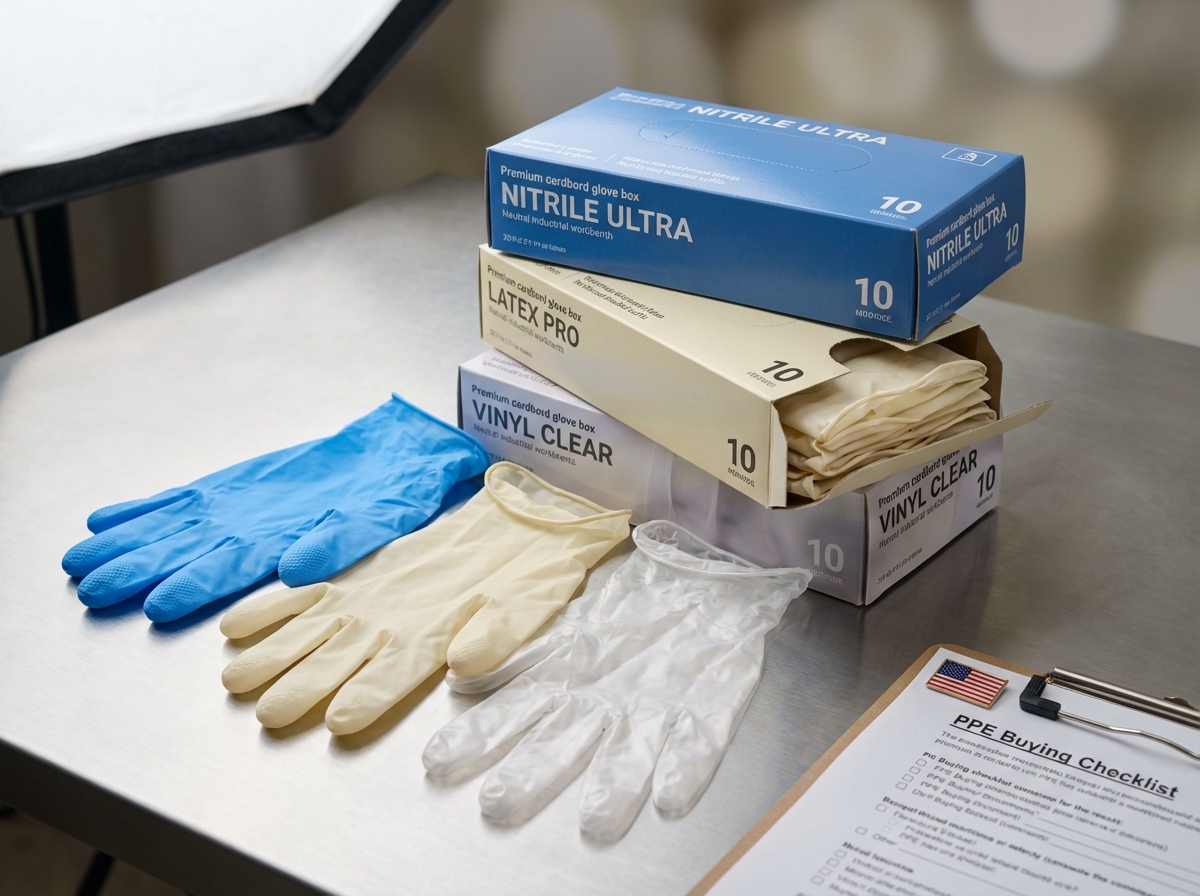
Choosing the right disposable glove is critical for safety, comfort, and compliance. This guide compares nitrile, latex, and vinyl gloves across protection, fit, standards, and costs for healthcare, industrial, and food-service work in the U.S. Read on for practical buying advice, performance trade-offs, and disposal considerations to help you select the best glove for your job.
How glove materials are made and how that affects performance
The performance of a disposable glove starts with its molecular structure. Every material used in the industry today has a specific chemical makeup that dictates how it reacts to chemicals, how much it can stretch, and how easily it punctures. Understanding these differences is the first step in choosing the right protection for a specific job.
The Chemistry of Glove Materials
Nitrile gloves are made from Nitrile Butadiene Rubber (NBR), a synthetic copolymer created by combining acrylonitrile and butadiene. The ratio of these two chemicals determines the final properties of the glove. A higher acrylonitrile content increases chemical resistance but makes the material stiffer, while the butadiene component provides flexibility and a softer feel. Because nitrile is entirely synthetic, it contains no natural rubber proteins, making it the primary choice for environments where latex allergies are a concern.
Natural rubber latex comes from the sap of the Hevea brasiliensis tree. It is composed of 1,4-polyisoprene, which gives it incredible elasticity. The polymer chains in latex are long and tangled, allowing them to stretch significantly and return to their original shape without losing integrity. However, latex contains naturally occurring proteins that can trigger immune responses in sensitive individuals. Even with modern processing, these proteins remain a critical factor in workplace safety decisions.
Vinyl gloves are manufactured from polyvinyl chloride (PVC). On its own, PVC is a rigid plastic used for pipes and construction. To make it flexible enough for a glove, manufacturers add plasticizers. These chemicals sit between the PVC polymer chains to allow them to slide past each other. Most modern vinyl gloves use phthalate-free plasticizers to meet safety regulations. Unlike nitrile or latex, vinyl is not an elastomer; it lacks “memory” and will not snap back to its original shape once stretched. This lack of elasticity causes vinyl gloves to feel loose and bag around the wrist.
The Manufacturing and Dipping Process
The production of all three types follows a similar dipping process. It begins with hand-shaped molds called formers, usually made of ceramic or aluminum. These formers are cleaned thoroughly with acid and water to remove debris. Once clean, they are dipped into a coagulant solution, typically calcium nitrate, which helps the liquid glove material adhere to the mold evenly.
After the coagulant dries, the formers move into the polymer tank. For nitrile and latex, this is a vat of liquid rubber; for vinyl, it is a plastisol mixture. The thickness of the glove is controlled by the speed of the dipping line and the concentration of the liquid. Once the material is on the former, it goes through a series of ovens for curing and vulcanization. In nitrile and latex production, sulfur and accelerators are used to create cross-links between polymer chains, giving the gloves their strength and elasticity.
Leaching is a critical step that follows curing. The gloves are washed in hot water to remove excess chemicals and, in the case of latex, to reduce the concentration of allergenic proteins. This step is vital for ensuring the glove is safe for skin contact and does not cause irritation during long shifts.
Post-Processing and Surface Treatments
Once cured and leached, gloves undergo finishing treatments to facilitate donning. While manufacturers historically used cornstarch powder, respiratory risks and contamination issues have led most industries to move to powder-free finishes.
Chlorination is the most common method for creating a powder-free glove. The gloves are exposed to chlorine gas or a solution that reacts with the material’s surface. This process makes the surface harder and less “tacky,” allowing the glove to slide onto the hand easily. Chlorination also helps reduce protein levels in latex gloves.
Polymer coating is an alternative to chlorination. A thin layer of polyurethane or silicone is applied to the interior of the glove, creating a smooth barrier that reduces friction against the skin. Many high-end nitrile gloves use this method to maintain material integrity while providing a silk-like feel.
Physical Properties and Performance Metrics
The performance of a glove is measured by several key metrics:
- Tensile strength: The force required to pull the glove until it breaks. Nitrile generally leads in this category, offering high resistance to tearing.
- Elongation at break: How far a glove can stretch before snapping. Latex is the clear winner, often stretching to 700 percent or more of its original length.
- Puncture resistance: Nitrile excels here, being significantly tougher than both latex and vinyl. It is the standard for industrial and automotive work where sharp edges are common.
- Barrier integrity (AQL): The Acceptable Quality Level indicates the probability of pinhole leaks. While all medical-grade gloves must meet strict AQL standards, the inherent durability of nitrile often provides a more reliable barrier over long periods.
- Thickness: Measured in mils (one-thousandth of an inch). Lightweight gloves (3–4 mils) offer tactile sensitivity for food service or clinical exams. Midweight gloves (4–6 mils) are workhorses for medical and lab fields. Heavy-duty gloves (6–12+ mils) are designed for high-risk chemical or mechanical environments.
Practical Implications for the User
The choice of material affects the daily experience of the wearer. Nitrile offers the best chemical resistance, especially against oils, greases, and petroleum-based products. This makes it the preferred choice for the nitrile gloves market which continues to grow in industrial sectors. It also features textured fingertips in many designs to improve grip in wet or oily conditions.
Latex provides the most “natural” fit, conforming to the hand to reduce fatigue during long procedures. However, the risk of Type I allergies remains a significant drawback. Vinyl is the most cost-effective option, ideal for low-risk tasks like food preparation or light cleaning. Because it lacks elasticity, it does not provide a snug fit, which is a disadvantage when precision is required.
Summary of Material Attributes
Nitrile Performance
Chemistry: Synthetic Nitrile Butadiene Rubber (NBR)
Strength: High puncture and tear resistance
Elasticity: Moderate stretch with good memory
Fit: Snug; conforms to hand with body heat
Best For: Chemical handling, medical exams, and automotive work
Latex Performance
Chemistry: Natural Rubber Latex (1,4-polyisoprene)
Strength: High tensile strength but prone to punctures
Elasticity: Superior stretch and recovery
Fit: Second-skin feel with maximum tactile sensitivity
Best For: Surgery and high-precision laboratory tasks
Vinyl Performance
Chemistry: Polyvinyl Chloride (PVC) with plasticizers
Strength: Low durability; prone to tearing
Elasticity: Very low with no memory
Fit: Loose and baggy around the wrist
Best For: Short-duration food service and low-risk cleaning
Real world performance and which glove to choose by application
Choosing the right glove depends on the specific risks faced daily. While material properties matter, performance in a clinical setting differs vastly from an auto shop. Buyers must evaluate the Acceptable Quality Level (AQL) before bulk purchasing. A lower AQL number indicates fewer defects per batch. Standard medical exam gloves typically require an AQL of 2.5 or lower. Surgical gloves demand a tighter standard, usually an AQL of 0.65 or 1.0, because the stakes for infection are higher.
Healthcare and Clinical Exams
Primary Hazards
Healthcare workers deal with bloodborne pathogens, bodily fluids, and infectious diseases. The main goal is a reliable viral barrier.
Recommended Properties
Nitrile is the top choice for general exams in 2025. It meets ASTM D6319 standards and provides a strong barrier against viral penetration as tested by ASTM F1671. Most hospitals use a 3 to 4 mil nitrile glove for standard rounds. Latex is an acceptable alternative if there are no allergy concerns, as it offers better tactile sensitivity for palpating veins. However, the shift toward nitrile is nearly complete in most U.S. health systems. Look for gloves labeled as chemotherapy-rated if handling oncology drugs, as these are tested against specific permeation timelines (ASTM D6978).
Surgical and Sterile Contexts
Primary Hazards
Risks include deep tissue exposure and long-term contact with internal organs. Sterility is non-negotiable.
Recommended Properties
Surgical gloves are hand-specific rather than ambidextrous to reduce fatigue during long procedures. While latex was the gold standard for fit, many surgeons now use polyisoprene or chloroprene. These synthetic materials mimic the stretch of latex without the protein risks. Double gloving is common practice; wearing a colored underglove beneath a standard top glove allows punctures to show through immediately via contrast color.
Laboratory Work with Chemicals
Primary Hazards
Lab technicians face splashes from acids, bases, and solvents. The hazard is chemical permeation rather than just physical tearing.
Recommended Properties
Nitrile is generally superior to latex for most lab chemicals, resisting oils, hexane, and many fuels. However, nitrile performs poorly against acetone or highly concentrated oxidizing acids. Always check the manufacturer’s permeation chart for the specific CAS number of the chemical in use. A 5 to 6 mil thickness is preferred to provide a buffer against accidental splashes.
Industrial and Automotive Tasks
Primary Hazards
Mechanics and factory workers deal with heavy oils, grease, sharp metal edges, and abrasive surfaces.
Recommended Properties
Heavy-duty nitrile is the standard here. A thickness of 6 to 8 mils (or higher) is necessary. Many industrial gloves feature a raised diamond texture to help grip oily parts. Nitrile stays intact when exposed to gasoline and motor oil, whereas latex or vinyl degrade rapidly. Thicker gloves also prevent snags that lead to skin tears. Black nitrile is preferred as it hides grease and grime, maintaining a professional appearance.
Food Handling and Service
Primary Hazards
Risks are primarily cross-contamination and foodborne illnesses like salmonella.
Recommended Properties
Vinyl gloves are common in food service because they are inexpensive for tasks requiring frequent changes, such as making sandwiches or plating food. However, vinyl is brittle. If prepping raw meat or using knives, a 3 mil nitrile glove is safer. Nitrile is more puncture-resistant and fits tighter, preventing the glove from getting caught in prep equipment. You can read more about how these choices are shifting in this look at 2025’s Game-Changers: What’s New in Nitrile vs Vinyl Gloves.
Cleaning and Janitorial Use
Primary Hazards
Janitors deal with harsh disinfectants, bleach, and potential biological waste.
Recommended Properties
A midweight nitrile glove around 5 mils offers the best balance of protection and cost, resisting common industrial cleaners better than vinyl. For strong stripping chemicals, a specialty glove made of neoprene may be required. For standard cleaning, nitrile provides the necessary barrier against bacteria. Vinyl is often too thin and prone to leaking when submerged in cleaning buckets.
Beauty and Hair Salons
Primary Hazards
Stylists are exposed to hair dyes, bleaches, and permanent wave solutions that can cause contact dermatitis.
Recommended Properties
Black nitrile is the industry standard for salons. It resists hair color chemicals and does not stain. While latex is an alternative, client sensitivities make nitrile the safer business choice. A 3 to 4 mil thickness allows for the dexterity needed to handle foils and shears while protecting skin from irritation.
Chemical Performance Summary
- Nitrile: Excellent against petroleum products, greases, and many acids. The best all-around chemical performer for disposables.
- Latex: Handles biological hazards and some acids well but fails quickly against oils or organic solvents.
- Vinyl: Very limited chemical resistance. Acceptable for water-based liquids but dissolves or permeates quickly with solvents or fats.
As the market evolves, material costs fluctuate. You can find details on pricing trends in the April 2025 Glove Market Outlook. Choosing the right thickness is as important as the material; a 6 mil glove provides significantly more breakthrough time than a 3 mil glove. For high-risk environments, always prioritize ASTM ratings over price per box.
Practical buying tips sizing standards and cost considerations
Procuring disposable gloves involves more than comparing prices per case. Physical dimensions and technical specifications directly impact staff safety and workflow.
Sizing and Fit
A glove that is too tight causes hand fatigue and increases tearing risk; a glove that is too loose reduces tactile sensitivity and creates snag hazards. To find the correct size, measure the width of the palm just below the knuckles.
* Small: 2.75 to 3 inches
* Medium: 3 to 3.5 inches
* Large: 3.5 to 4 inches
* Extra Large: > 4 inches
Most disposable gloves are ambidextrous, simplifying dispensing. Hand-specific gloves are generally reserved for surgical settings requiring ergonomic precision.
Thickness Strategy
While material properties define performance, thickness—measured in mils—dictates durability.
* 2–3 mil: Light duties (food prep, basic cleaning). Best dexterity.
* 4–5 mil: Clinical exams. Standard medical grade.
* 6–8+ mil: Industrial/Automotive. Required to prevent punctures from tools and sharp edges.
Thicker gloves improve chemical resistance but reduce tactile sensitivity.
Certifications and Standards
To ensure legality and safety, verify certifications. In the U.S., medical gloves must have FDA 510(k) clearance. Look for these ASTM standards on the packaging:
* ASTM D6319: Nitrile exam gloves.
* ASTM D3578: Latex exam gloves.
* ASTM D5250: Vinyl exam gloves.
* ASTM D6978: Chemotherapy drug resistance (critical for oncology).
Imported gloves may carry EN 455 (medical) or EN 374 (chemical/microorganism) markings, which are European standards.
Quality Control (AQL)
The AQL represents the maximum percentage of defective gloves allowed in a batch.
* Medical Exam: FDA requires AQL 2.5 or lower. High-end brands often offer AQL 1.5.
* Surgical: Typically AQL 0.65.
* Industrial: Often AQL 4.0.
For hazardous pathogens or chemicals, insist on a lower AQL to minimize pinhole leak risks.
Powder and Sterility
Powdered gloves are banned in U.S. healthcare (since 2017) due to respiratory and inflammation risks. Ensure you purchase powder-free options, which use chlorination or polymer coatings for donning. Choose sterile gloves (individually wrapped) for invasive procedures and non-sterile (bulk box) for standard exams.
Color Coding
* Blue/Purple: Standard healthcare nitrile.
* Black: Automotive/Tattoo (hides grease/ink).
* Clear/White: Food service vinyl.
* High-Vis Orange/Green: Industrial safety.
Cost and Market Trends
Prices fluctuate based on raw materials and logistics. As of late 2025, bulk pricing for nitrile exam gloves typically ranges between $12 and $18 per box of 100. Latex gloves generally cost $10 to $15 per box. Vinyl remains the most affordable at $4 to $7 per box. Specialty gloves (extra thick/extended cuff) command a premium. See the April 2025 Glove Market Outlook for current data.
Vendor Vetting and Storage
Always request a Certificate of Analysis for shipments to prove the batch met standards. Request samples for staff testing—perform a simple water leak test to verify integrity. Proper storage extends shelf life (3–5 years for nitrile/vinyl, ~3 years for latex). Store boxes in cool, dark, dry places; UV light and heat degrade these materials rapidly.
Right-Sizing Inventory
Use the most cost-effective glove that safely performs the task. Do not use expensive nitrile exam gloves for light dusting where vinyl suffices. Consolidate purchasing to reach bulk thresholds and implement First-In, First-Out (FIFO) rotation. For market evolution insights, read 2025’s Game-Changers: What’s New in Nitrile vs Vinyl Gloves.
Frequently Asked Questions
This section addresses common operational questions regarding glove usage and safety in professional facilities.
Can nitrile gloves cause allergic reactions?
While nitrile eliminates the risk of Type I latex allergies (caused by natural rubber proteins), some users may still experience contact dermatitis. This is often a Type IV allergy caused by chemical accelerators (like carbamates or thiazoles) used during manufacturing. If staff members develop irritation, look for “accelerator-free” nitrile gloves. The nitrile gloves market is increasingly offering these specialized low-dermatitis options.
Are nitrile gloves truly disposable or can they be reused safely?
Nitrile gloves are designed for single use only. Reusing them significantly increases the risk of micro-tears and cross-contamination. Washing them with alcohol or soap degrades the material integrity, creating invisible holes. Always discard gloves after a single patient contact or specific task. Safe reuse is not possible as the structural stability of the synthetic rubber fails after the first application.
Is vinyl an acceptable choice for food service?
Vinyl is acceptable for short-duration tasks involving dry goods or sandwich assembly. However, avoid vinyl when handling hot or fatty foods, as plasticizers can leach into the food. Furthermore, vinyl has a high failure rate under tension. According to 2025 industry trends, nitrile is increasingly replacing vinyl for tasks requiring a reliable barrier or knife work.
What are the best methods for glove disposal and environmental management?
Most disposable gloves end up in landfills. However, the disposable gloves market is seeing a rise in biodegradable nitrile options. Never incinerate vinyl gloves, as they release toxic hydrogen chloride gas. Always follow local biohazard protocols when disposing of gloves used in medical or laboratory settings.
What are the best tips for donning and doffing gloves to prevent contamination?
Always wash and dry hands before donning. When removing, use the “glove-to-glove” and “skin-to-skin” technique: pinch the palm of one glove to peel it off, then slide bare fingers under the remaining cuff to remove the second, trapping the first inside. This ensures the contaminated surface remains contained. Proper technique is as vital as glove quality in preventing pathogen spread.
Key conclusions and buying checklist
| Application Type | Recommended Material | Primary Benefit |
|---|---|---|
| General Purpose and Industrial | Nitrile (3 to 5 mil) | High puncture resistance and chemical protection |
| Tactile Medical Exams | Latex or Thin Nitrile (2 to 3 mil) | Superior touch sensitivity and precision |
| Low-Risk Food Service | Vinyl | Cost-effective for frequent changes |
| Heavy Duty and Chemical Handling | Thick Nitrile (6 to 8+ mil) | Maximum barrier strength and durability |
Choosing the right glove requires balancing safety requirements with budget constraints. As indicated by the April 2025 Glove Market Outlook, nitrile remains the most reliable choice for long-term safety planning due to its chemical resistance and lack of latex proteins. To finalize your procurement strategy, ensure you address the following critical checkpoints:
- Verify Certifications: Confirm FDA 510(k) clearance for medical use and ASTM D6978 for chemotherapy handling.
- Conduct Fit Testing: Provide a range of sizes (XS–XL) and perform pilot tests to ensure gloves do not pinch or slip during standard tasks.
- Select Appropriate Thickness: Match the mil thickness to the hazard—3 mils for dexterity, 6+ mils for puncture and chemical risks.
- Specify AQL Ratings: Demand AQL 1.5 for high-risk medical environments and ensure industrial gloves meet at least AQL 4.0.
- Enforce Powder-Free: Stick to powder-free options to eliminate respiratory hazards and contamination risks.
- Audit Vendor Documentation: Require a Certificate of Analysis for every shipment to prevent counterfeit or substandard products, a rising concern in the 2025 import market.
- Plan for Disposal: Integrate waste management protocols, potentially utilizing biodegradable options or specialized recycling programs where available.
To make the best choice for your facility, request sample orders from multiple vendors to compare the actual feel and durability. If unsure about specific chemical compatibility, consult a safety manager or industrial hygienist to ensure your team has the highest level of protection available.
References
- 2025's Game-Changers: What's New in Nitrile vs Vinyl Gloves — While vinyl gloves retain a role in low-risk, short-duration tasks, nitrile gloves dominate 2025's safety landscape. Their adaptability to smart …
- Disposable Medical Gloves Market Size, Share, and Growth Analysis — Disposable Medical Gloves Market size was valued at USD 10.53 Billion in 2024 and is poised to grow from USD 11.22 Billion in 2025 to USD 18.56 Billion by …
- Disposable Gloves Market Outlook 2025 to 2035 — The Disposable Gloves Market Will Total USD 684.5 Billion In 2025, Forecasted To Rise Further To USD 2145.0 Billion By 2035, Rising At A CAGR Of 12.1%.
- U.S. Disposable Gloves Import Data Brief (Jan-Jul 2025) — China's share of U.S. medical nitrile and latex glove imports plummeted from 38.9% in 2024 to a mere 2.8% in the first seven months of 2025. …
- Nitrile Gloves Market Size & Share, Statistics Report 2025-2034 — The nitrile gloves market size exceeded USD 31.5 billion in 2024 and is expected to grow at a CAGR of 8% from 2025 to 2034, driven by rising adoption of …
- US Disposable Gloves Market Analysis – Size and Forecast 2025-2029 — The Disposable Gloves Market in US market size is expected to grow USD 1602.9 million from 2025-2029, expanding at a CAGR of 7.5% during the forecast …
- Global Disposable Nitrile Gloves Market Size, Report to 2033 — The global disposable nitrile gloves market size was USD 3.56 billion in 2024 & is projected to grow from USD 4.07 billion in 2025 to USD 11.77 billion by …
- April 2025 Glove Market Outlook: Nitrile Prices Rising, Vinyl Fading — As of April 2025, nitrile gloves are the safest, smartest choice for most industries—from medical to industrial to food service. But with global …
- Disposable Glove Types: Latex, Neoprene, Nitrile, and Vinyl — Nitrile provides users with excellent tensile strength and the following: snag-, abrasion-, and puncture-resistant. Nitrile is also latex-free, …
Legal Disclaimers & Brand Notices
The content provided in this article is for informational purposes only and does not constitute professional medical advice, diagnosis, or treatment. Always seek the advice of a qualified healthcare professional or safety specialist regarding the selection and use of personal protective equipment for specific medical procedures, clinical environments, or hazardous material handling.
All product names, logos, and brands mentioned in this text are the property of their respective owners. All company, product, and service names used in this article are for identification purposes only. Use of these names, logos, and brands does not imply endorsement.